
By The Best Bamboo® · Published 8th August 2026
Technical review: Esteban Morales Montoya, Civil Engineer — bambooengineers.com
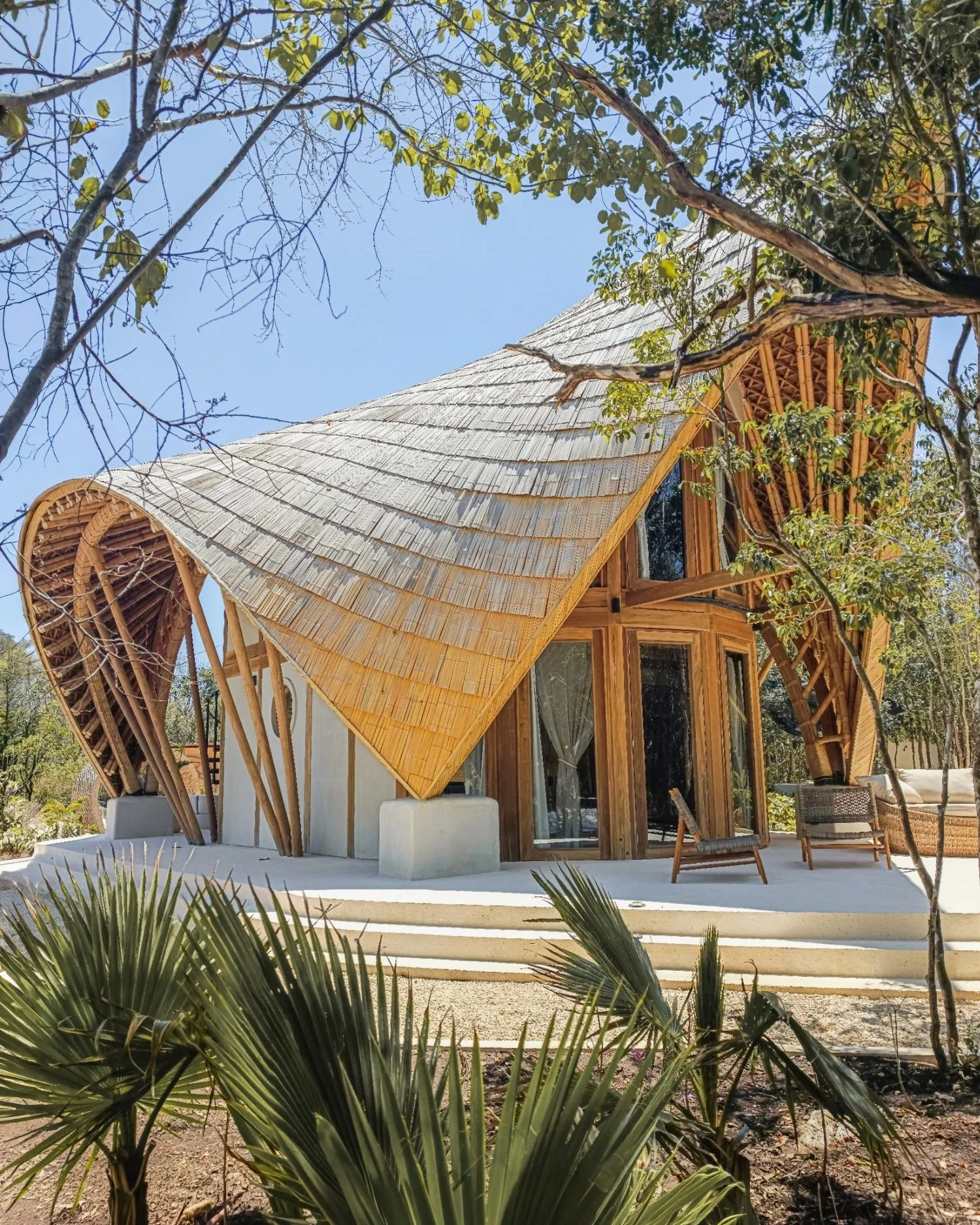
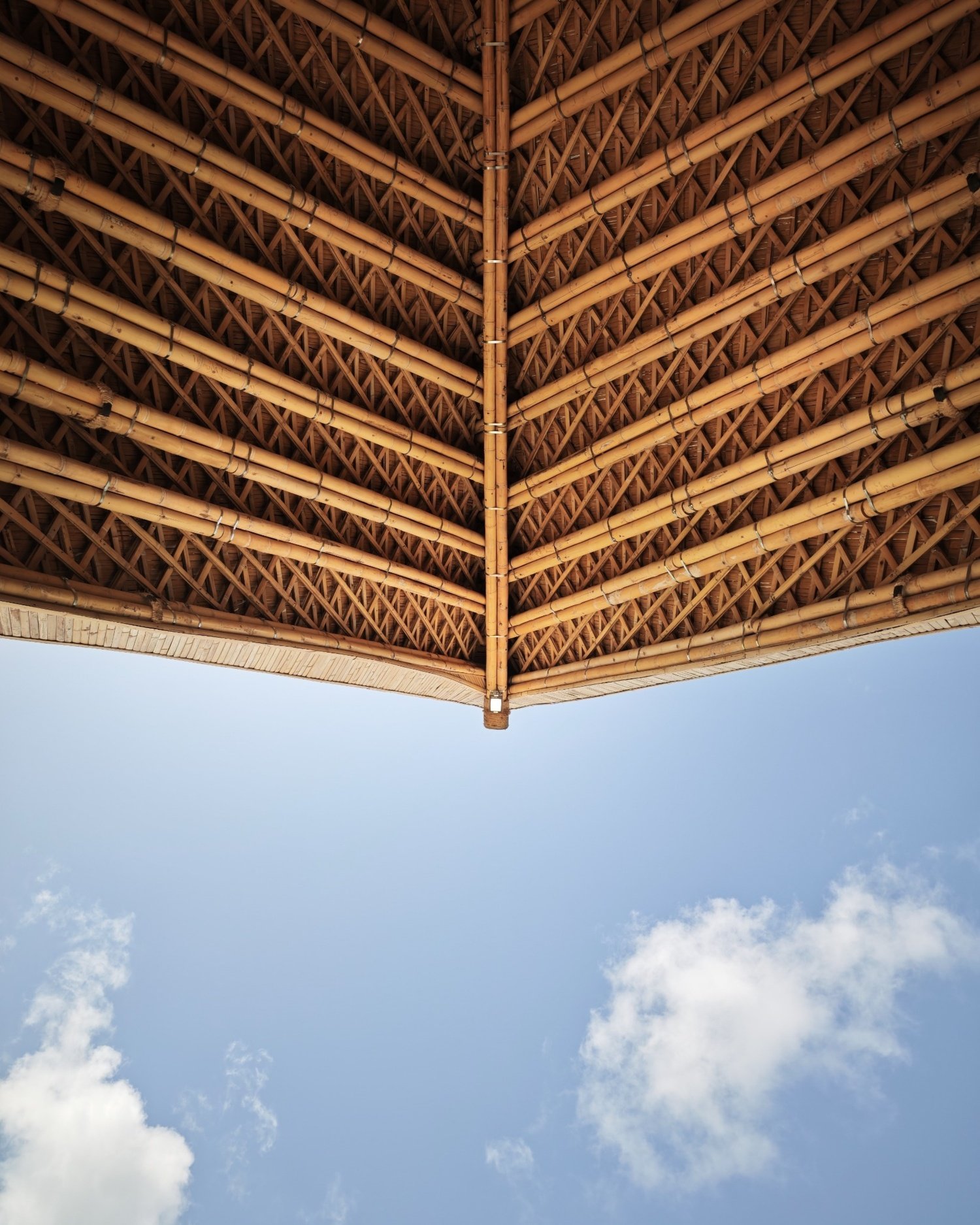
Bamboo structure by terrAurea studio. Architecture by Giovanni Presti; structural engineering by Esteban Morales
Short answer: Guadua bamboo isn't “carbon negative” in the way most marketing claims. What it does have is a very low fossil-carbon footprint at the product stage, because a culm is cut, cured and treated — not fired in a kiln. In a peer-reviewed Colombian study, a Guadua bahareque house came in more than 60% below an equivalent brick-and-steel house on embodied carbon. That's the real number, and it's good enough.
Concrete built the modern world. It also carries a cost the industry spent decades not discussing: cement is responsible for somewhere between 6% and 8% of global CO₂ emissions, depending on whose accounting boundary you use. If it were a country, it would rank third or fourth among emitters.
That range is worth pausing on, because it tells you something about the state of the evidence. The World Economic Forum puts cement near 8% of global CO₂. USGS figures via Our World in Data put direct cement CO₂ at roughly 1.47 billion tonnes in 2024 — around 7%. Statista reports 2.4 billion tonnes of CO₂e for 2023, about 6% — a different gas basket and a wider boundary. All three are defensible. None is “the settled figure,” and anyone who tells you otherwise hasn't read the footnotes.
That carbon problem sits at the heart of climate change, because construction and the materials it consumes account for a large share of global emissions — and the buildings going up this decade will still be emitting, or storing carbon, for generations. Cutting the embodied carbon of what we build is one of the more direct levers the sector has.
We've grown, harvested and exported Guadua Angustifolia from our plantation in Montenegro, Quindío, Colombia for nearly twenty years. This article states the carbon case for bio-based, low-carbon construction materials the way a specifier needs to see it: with boundaries declared, sources linked, and the weak parts of the argument named rather than hidden.
Why cement emissions can't be fixed with efficiency
It would be easy to assume the cement industry simply hasn't tried. It has. The Global Cement and Concrete Association reported at COP30 in November 2025 that the sector has cut the CO₂ intensity of cementitious products by 25% since 1990, through cleaner kilns, alternative fuels and lower clinker ratios.
But note the word intensity. That's emissions per tonne of product. Absolute emissions from cement have more than doubled since 2000, because intensity fell more slowly than volume rose.
One nuance the industry rightly raises and the sustainability sector usually ignores: concrete reabsorbs CO₂ over its life through carbonation. The best current estimate is cumulative uptake of 23.9 Gt CO₂ between 1930 and 2023 — about 52% of cement's process emissions over the same period. That's a real and large number. It's also slow, spread over a century, and does nothing about the fuel emissions from the kiln. It changes the size of the problem, not its character.
The core difficulty is chemistry, not effort. Turning limestone into clinker releases CO₂ as an unavoidable product of the reaction — decarbonate the rock however cleanly you like, and the carbon still comes out. That's why cement is classed as "hard to abate." Carbon capture may eventually help; it's expensive, unproven at global scale, and years from making a dent.
Global demand is not still climbing. Global cement production has been flat at roughly 4 billion tonnes for a decade. China — still nearly half the world total — produced 1,900 Mt in 2024, dipping below 50% of global output for the first time since 2008. Growth has shifted to India (450 Mt in 2024, up 7.1%), Southeast Asia and Africa. Volume has plateaued; absolute emissions remain near record highs. Both things are true.
There's another path that needs no new technology: build more of the world with materials whose production doesn't involve calcining rock.
What a Guadua plantation actually stores
Guadua Angustifolia Kunth is the largest bamboo native to the Americas. Three properties matter for carbon.
Speed. A culm reaches full height in roughly six months. It reaches structural maturity — the lignification that gives it strength — at three to five years. A newly established plantation reaches first commercial harvest at four to six years. These are three different numbers, and they get conflated constantly in bamboo marketing, including ours. The six-month figure is the striking one — and it refers to height, not usable strength.
Perpetual stand. The rhizome system isn't destroyed when a culm is cut. A managed guadual keeps producing without replanting; a field study puts a sustainable cut at around 840 culms per hectare per year. No clear-fell, no replant cycle, no bare ground.
Standing carbon. Here we have to be more careful than the industry usually is, because published values for Guadua vary by a factor of eight depending on what's inside the system boundary:
| Study | Reported value | What's inside the boundary |
|---|---|---|
| Plantation, Pereira coffee region (CATIE) | 76 t CO₂/ha | Biomass only; 83% aboveground; est. 2003, 625 clumps/ha |
| Review in Scientific Reports, 2024 | 149.9–328.4 t CO₂/ha | Natural or planted Guadua; varies by age, area, country |
| Guadua forest, SW of Pereira | ≈672 t CO₂/ha | Total: 22% biomass + 78% soil to 45 cm depth |
| Coffee Region inventory (Kleinn & Morales-Hidalgo) | 156 t C/ha | 6,940 culms/ha; 311 t/ha oven-dry biomass |
| Review of 184 studies, 70 species (Yuen et al.) | 94–392 Mg C/ha total ecosystem carbon | Bamboo below most forest types; ~ rubber plantations |
We've previously described Guadua forests as among the most efficient carbon sinks in the tropical Americas. On the evidence above, that's not a claim we can support. Yuen's review — the broadest available — places bamboo below most forest types on total ecosystem carbon, above agroforests and oil palm, roughly level with rubber plantations. Guadua is a genuinely productive, fast-cycling, soil-building crop. It isn't the champion sink of the Americas, and the case doesn't need it to be.
The carbon argument for bamboo in construction was never really about the plantation. It's about what happens at the factory gate.
How embodied carbon is actually counted
This is the part most bamboo marketing gets wrong — including our own earlier writing — and it matters because it's the part a European specifier will check.
The common claim: bamboo absorbs carbon while it grows, and when it becomes a beam that carbon stays locked away for the life of the building. Physically, true. In the accounting framework that will govern European building permits, that's not how the number works.
Under EN 15804+A2 and EN 15978 — the standards behind the EU's whole-life carbon rules — biogenic carbon is reported with the −1/+1 convention. Uptake is counted as negative in the product stage (A1–A3) and released as positive at end of life (C3/C4). Netted across the full life cycle, biogenic carbon is approximately zero unless the material is reused or credited separately in Module D. Temporary storage is disclosed — but it doesn't become a permanent credit just because the beam is still standing.
So what's the real advantage?
Guadua's fossil GWP in A1–A3 is very low. A culm is cut, cured, treated with boron salts and shipped. No clinker. No 1,450 °C kiln. No ore reduction. The comparison to concrete isn't “we store carbon and they emit it.” It's “our product stage barely emits at all — and on top of that, we disclose stored biogenic carbon.”
That claim is smaller. It's also much harder to attack, and it fits directly into the box a specifier has to fill in.
A related point bamboo suppliers rarely make honestly: processing is what drives bamboo's footprint. A recent review of engineered bamboo found embodied carbon rising with each level of processing and densification, with minimally processed culms at the low end. The published figures bear this out:
| Product | Cradle-to-gate (A1–A3) | Source |
|---|---|---|
| Whole culm, minimally processed | Very low; no product-specific EPD published | Renew. & Sust. Energy Rev., 2026 |
| Structural glued laminated bamboo (moso) | 467 ± 9 kg CO₂e/m³; stores 1,140 kg CO₂e/m³ biogenic; ~156 with energy recovery | J. Cleaner Production, 2024 |
| Bamboo scrimber flooring | 1,571–1,846 kg CO₂e/m³ | Sustainability (MDPI), 2026 |
| Ready-mix concrete C30/37, 35% cement replacement | ≈240 kg CO₂e/m³ | MPA 2018 / IStructE |
| Concrete C32/40, 25% GGBS | 0.120 kg CO₂e/kg | ICE Database v3 |
| Concrete C32/40, 75% GGBS | 0.063 kg CO₂e/kg | ICE Database v3 |
Two things follow that are uncomfortable for the bamboo industry. First, a heavily processed bamboo product can carry a higher per-cubic-metre footprint than a well-specified low-clinker concrete. Second, none of these are our numbers — they're literature values with different boundaries and reference years, which is exactly why they can't be used in a permit calculation.
The only figures that count in a life-cycle assessment come from a verified Environmental Product Declaration under EN 15804+A2. We don't yet publish one for our culms. Ask us — and ask every other supplier — for verified data rather than a claim in a brochure. Anyone who quotes you a carbon figure without an EPD behind it is quoting the literature, not their product.
What it looks like at building level
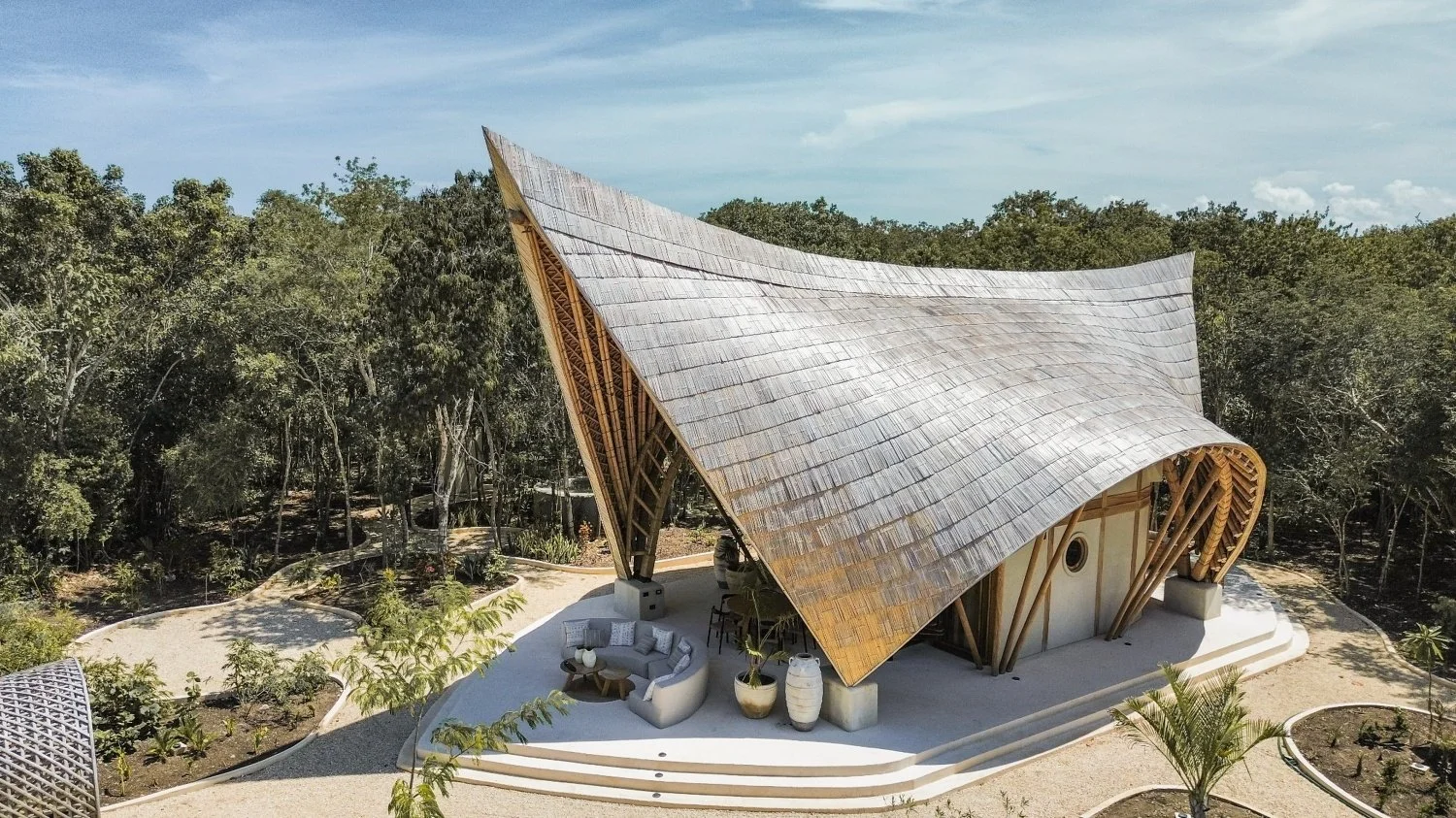
Guadua bamboo structure by terrAurea studio. Architecture by Giovanni Presti, structural engineering by Esteban Morales.
Material-level numbers only get you so far. The most useful figure we know of for Guadua is at building level, and it comes from a peer-reviewed Colombian study.
Researchers compared a social-housing unit built as a light cement-bamboo frame — bahareque encementado, using Guadua Angustifolia — against an equivalent conventional house in clay brick with steel. Both used reinforced-concrete strip foundations and ground slabs. The bamboo house came in more than 60% below the brick house on embodied carbon.
Note what that comparison does and doesn't say. It's a like-for-like of two real social-housing typologies in Colombia. It includes the concrete both buildings still need. It's one climate, one typology, one supply chain. It is not a licence to claim 60% on your project.
But as an order of magnitude, it's the number to argue from — far more defensible than a hectare-of-plantation figure, because it describes a building, which is what your regulator will assess.
The regulation that actually changes the decision
For years the carbon argument for materials was moral. What's changing it is disclosure with teeth — and it's worth being precise about which mechanism does what, because the two get confused constantly.
The EU Carbon Border Adjustment Mechanism (CBAM) is not the relevant one. CBAM covers cement, iron and steel, aluminium, fertilisers, electricity and hydrogen. Bamboo isn't in scope and receives no credit. CBAM also applies only to imports into the EU — European cement is priced by the ETS, not by CBAM. Its definitive phase began 1 January 2026; certificate sales open 1 February 2027; the first declaration, covering 2026 imports, falls due 30 September 2027. A 50-tonne annual de minimis threshold exempts around 90% of importers, and the paid share phases in from 2.5% in 2026 to 100% in 2034. Useful to understand — not the thing that puts bio-based materials on your drawing.
The mechanism that does is the recast Energy Performance of Buildings Directive, (EU) 2024/1275. Under Article 7, life-cycle Global Warming Potential must be calculated and disclosed in the building's energy performance certificate:
• from 1 January 2028 for all new buildings over 1,000 m²;
• from 1 January 2030 for all new buildings.
By 1 January 2027, every Member State must publish a roadmap introducing limit values on total life-cycle GWP, with targets from 2030 and a declining trend. The methodology is EN 15978, and the Commission adopted the common calculation framework in December 2025.
And several countries are already ahead of the directive:
• Denmark was the first country in the world to impose mandatory CO₂e limits on new buildings over 1,000 m² — starting at 12 kg CO₂e/m²/year, tightened in 2025, with further steps in 2027 and 2029, plus a separate 1.5 kg CO₂e/m²/year cap on construction-stage emissions (A4–A5).
• France has applied embodied-carbon limit values under RE2020 since 2022, tightening in 2025, 2028 and 2031.
• Sweden has required a mandatory climate declaration (A1–A5) on new buildings since January 2022.
The practical consequence for anyone specifying materials: from 2028 you're not making an argument about carbon, you're filling in a number. A material with low product-stage emissions and verified data helps you meet a threshold. A material with a good story and no EPD isn't usable at all.
One point worth checking with your customs adviser: the EU Deforestation Regulation covers seven commodities — cattle, cocoa, coffee, oil palm, rubber, soy and wood. A delegated act adopted on 13 July 2026 states that products made from bamboo, rattan and similar materials fall outside its scope, though the text remains in the scrutiny period and the current Annex I stays binding until publication. If confirmed, bamboo carries a materially lighter compliance burden into the EU than timber.
Where bamboo genuinely competes — and where it doesn't
Overclaiming is how good arguments get dismissed, so here's the boundary.
Bamboo doesn't replace concrete everywhere. Foundations, high-rise cores and major infrastructure still rely on conventional materials — and the Colombian bahareque study is a good reminder: even the bamboo house sat on a reinforced-concrete foundation. Anyone selling you a single material as the answer to construction's carbon problem is selling you something.
The real opportunity is displacement at the margin — low- and mid-rise buildings, structural frames, roof structures, cladding, interior systems, pavilions, social housing. The share of construction where a bio-based material is a legitimate structural choice is larger than most specifiers assume, and in the context of climate change every cubic metre of concrete not poured is embodied carbon avoided — a small, real contribution from a material that grew by pulling CO₂ out of the air.
You don't need bamboo to replace concrete. You need it to replace enough of it.
Durability: the condition the whole argument depends on
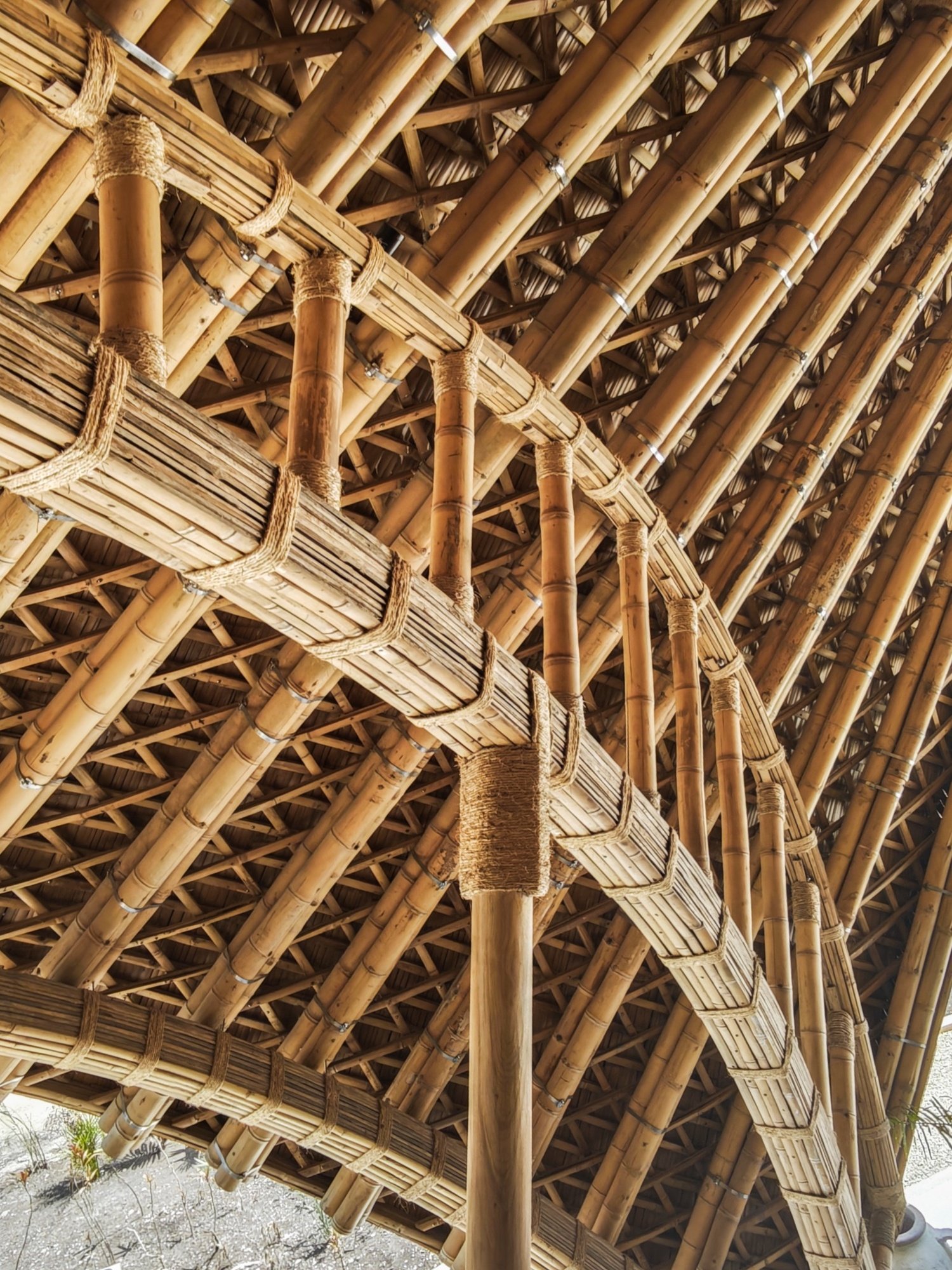
Structural bamboo connections rely on careful detailing. terrAurea studio; engineering by Esteban Morales.
If a culm rots in fifteen years, the carbon story ends there and the building has to be rebuilt with something else. Any honest account of bamboo's climate case has to include the condition attached to it.
Structural Guadua requires preservation — typically boron-salt treatment — and detailing that keeps it dry and off the ground. Properly treated and detailed, bamboo achieves high durability; the Institution of Structural Engineers says so explicitly in its ISO 22156 manual. Badly detailed, it doesn't, and no certificate of origin will save it.
The design framework now exists, and specifiers should ask for it by name:
• ISO 22156:2021 — structural design with bamboo culms
• ISO 19624:2018 — grading of bamboo culms
• ISO 22157 — test methods for physical and mechanical properties
• NSR-10, Title G, Chapter G.12 (Colombia) — seismic design with Guadua; NTC 5407 (connections), NTC 5525 (test methods)
• IStructE, Manual for the design of bamboo structures to ISO 22156:2021
Properties vary considerably even within one species from one country, which is why ISO 19624 requires grading tied to a specific species, supplier and source region. That's a supply-chain requirement as much as an engineering one — and it's the strongest practical argument for buying from a single identified plantation rather than an aggregated broker.
What “certified” actually means for Colombian Guadua
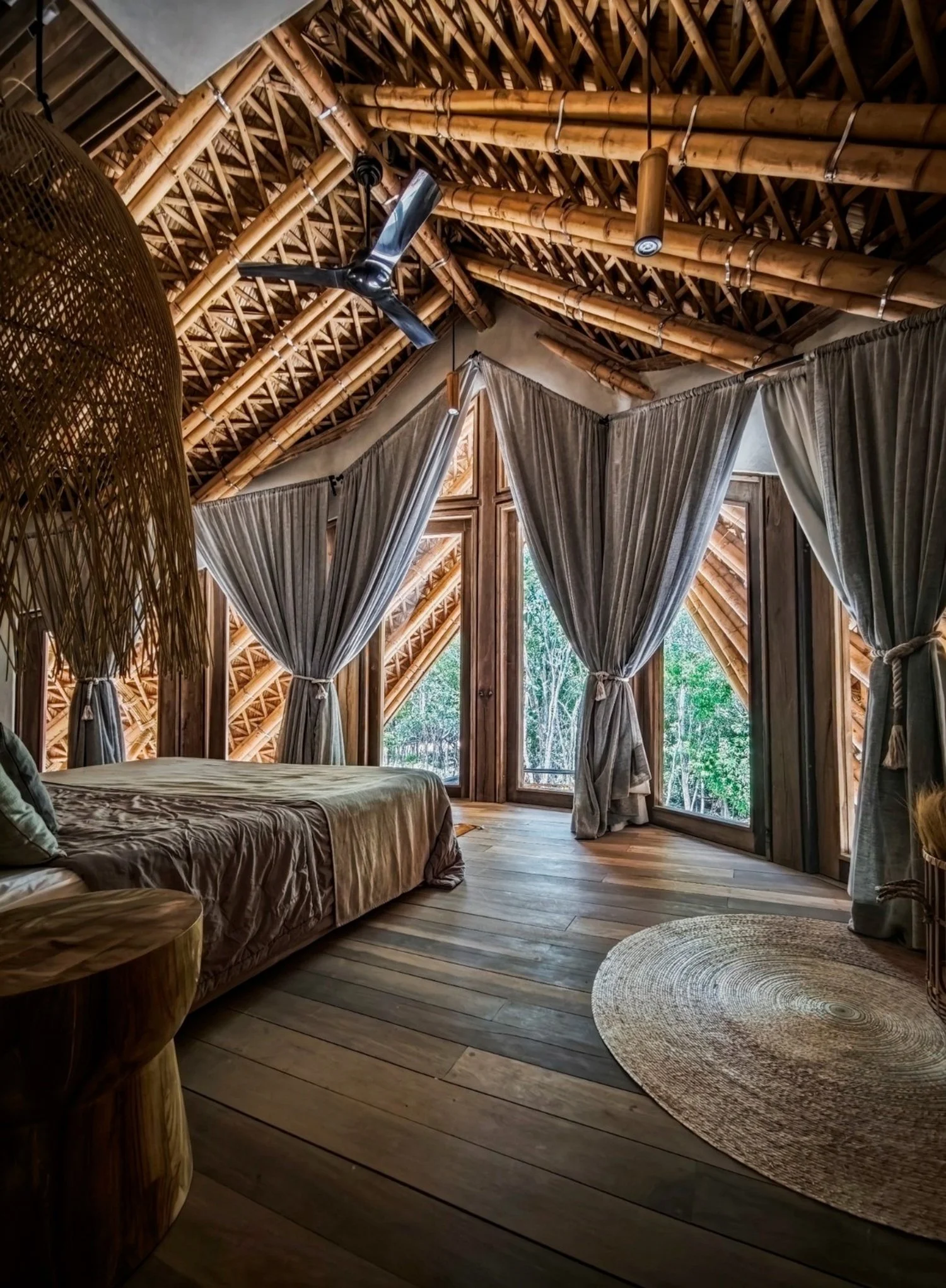
Interior of a Guadua structure — the exposed roof frame is the structural bamboo itself. terrAurea studio; architecture by Giovanni Presti
There's a claim we want to state more precisely than we have before, because the precise version is more useful than the vague one.
Our Guadua carries a certificate of origin issued by CRQ — the Corporación Autónoma Regional del Quindío, the regional environmental authority. CRQ issues certification for the export of forest products and the salvoconducto único nacional required to move material, shipment by shipment. That's legal compliance and chain of custody documented by a state authority.
It is not a voluntary sustainability certification in the sense of FSC — and we'd rather say so than let you assume otherwise and find out later.
What sits behind it matters more. Ley 2206 of 2022 reclassified guadua and bamboo stands in Colombia into three categories, with Category 3 being stands planted for productive purposes inside the agricultural frontier — legally distinct from natural forest. That distinction is the foundation of the claim we can make: our material comes from a planted, managed, registered production stand, not from wild harvesting of natural guadual. For a buyer building a due-diligence file, that's the sentence that matters.
Frequently asked questions
Is bamboo carbon negative?
Not under the standard used for European building assessment. Under EN 15804+A2, biogenic carbon is counted as negative uptake in A1–A3 and positive release at end of life, netting to roughly zero across the life cycle. Bamboo's real advantage is very low fossil emissions in the product stage, plus disclosed temporary storage.
How does bamboo compare to concrete on embodied carbon?
At building level, a peer-reviewed Colombian study found a Guadua bahareque social house more than 60% below an equivalent brick-and-steel house. At material level it depends heavily on processing: minimally processed culms are very low, while densified products like scrimber can exceed 1,500 kg CO₂e/m³.
How fast does Guadua grow?
A culm reaches full height in about six months, structural maturity at three to five years, and a new plantation reaches first commercial harvest at four to six years. Structural timber species are typically harvested at 25 to 50 years depending on species.
Does harvesting bamboo destroy the plantation?
No. Culms are cut selectively and the rhizome system remains intact, so the stand keeps producing without replanting. Field studies for Guadua indicate a sustainable cut of around 840 culms per hectare per year.
What certification should I ask a bamboo supplier for?
Three things: a certificate of origin naming the specific plantation; grading documentation to ISO 19624 for the species and source region; and a verified Environmental Product Declaration to EN 15804+A2 if you need to use the material in a life-cycle assessment. If a supplier can't provide the third, their carbon figures are literature values, not product data.
Can bamboo be used structurally in Europe?
Yes, with design to ISO 22156:2021 and species-specific characteristic values derived to ISO 22157. Consult a structural engineer experienced with bamboo; properties vary significantly by species, origin and grade.
Working with bio-based materials
If you're an architect, developer, builder or manufacturer looking at bio-based materials — and getting ahead of where carbon accounting and material regulation are heading — we supply the material and the documentation that goes with it.
We export certified Guadua Angustifolia worldwide from our plantation in Montenegro, Quindío, Colombia: poles, slats, panels and structural material, with certificate of origin.
Email: bamboo@thebestbamboo.com WhatsApp: +57 323 224 0640
Request the technical data pack — species data sheet / sample certificate of origin.
The Best Bamboo® is a direct exporter of certified Guadua Angustifolia bamboo from Colombia. This article addresses the environmental and regulatory case for bio-based construction materials; it contains no design recommendations or structural performance values. For the structural performance of bamboo in a specific application, consult a qualified structural engineer.